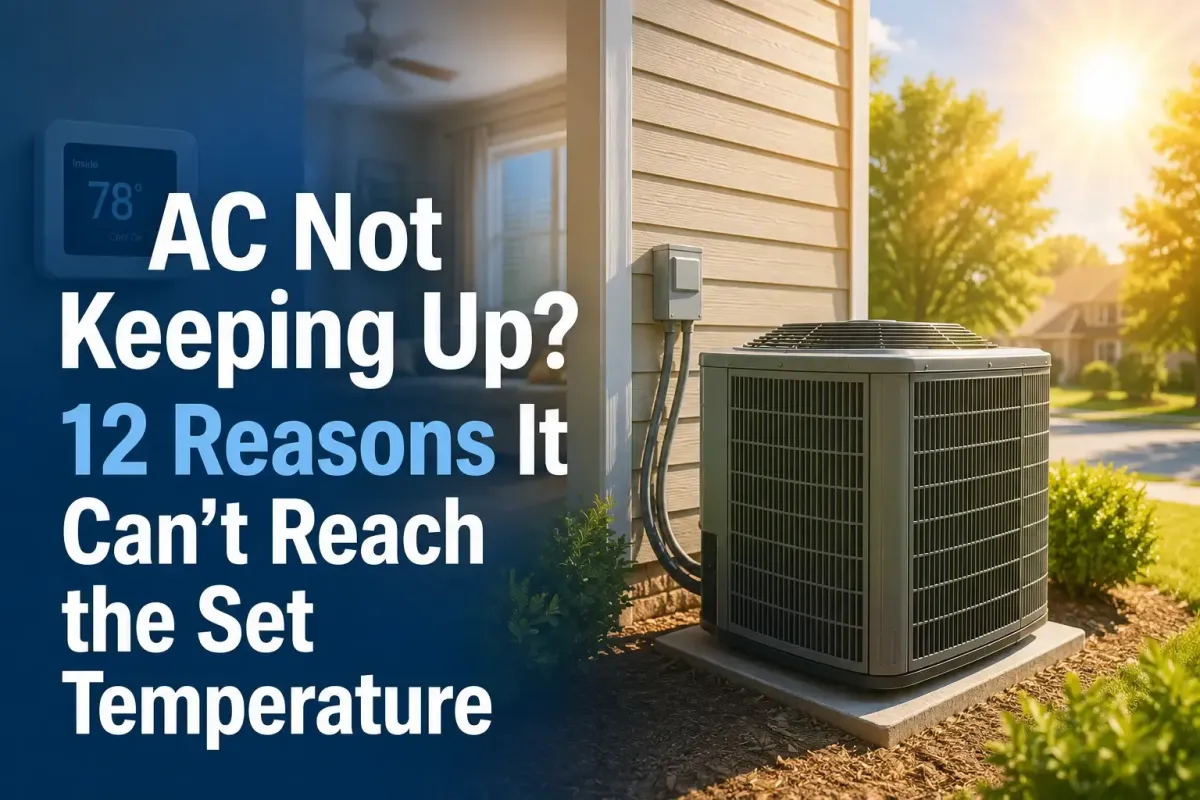
AC Not Keeping Up?
When your AC is not keeping up, the indoor temperature may continue climbing even though the system runs for hours.
A slight temperature difference during the hottest part of the afternoon can be normal, but warm air, weak airflow, ice buildup, unusual noises, or steadily rising indoor temperatures may indicate a problem.
An air conditioner may fall slightly behind during extreme heat and recover after sunset.
It is more likely to need service when it blows warm air, struggles in moderate weather, has weak airflow, freezes, leaks water, or cannot stop the indoor temperature from rising.
Before assuming the system has failed, check the thermostat, air filter, vents, and outdoor unit.
These simple checks can help you determine whether the AC is dealing with heavy demand or experiencing an airflow, mechanical, electrical, or refrigerant problem.
Why Is My AC Not Keeping Up With the Set Temperature?
An AC may not reach the set temperature when it cannot remove heat as quickly as heat enters the home.
This can happen during extreme weather, but it may also be caused by a dirty filter, blocked airflow, dirty coils, duct leakage, refrigerant loss, equipment problems, excessive heat gain, or incorrect system sizing.
The difference between the thermostat setting and the actual indoor temperature provides only part of the answer.
You also need to consider the air temperature at the vents, airflow strength, outdoor conditions, system run time, and whether the AC catches up after sunset.
An AC can also have a developing issue that only becomes obvious during peak heat.
A partially restricted filter, dirty condenser, weak capacitor, small refrigerant leak, or airflow problem may not noticeably affect comfort until the system must operate at full capacity.
Why Is My AC Not Cooling Enough on Hot Days?
Your home constantly gains heat through the roof, walls, windows, doors, appliances, air leaks, and occupants.
On very hot days, the AC may need to run continuously to offset that heat.
It may be normal for the indoor temperature to rise slightly during peak afternoon heat, particularly if the system catches up later in the evening.
However, it is less likely to be normal when:
The indoor temperature keeps rising
The AC blows warm or room-temperature air
Airflow is weaker than usual
The system struggles on milder days
Ice forms on the coil or refrigerant line
The breaker trips
The AC repeatedly starts and stops
Some rooms remain significantly warmer than others
The system cannot recover after sunset
Weather alone should not be blamed for every cooling problem.
High temperatures often reveal existing maintenance, airflow, duct, electrical, or equipment issues.
Should an AC Keep the House 20 Degrees Cooler Than Outside?
Not necessarily.
The idea that every air conditioner should keep a home exactly 20 degrees cooler than the outdoor temperature is an oversimplification.
Homeowners may also confuse two different temperature measurements:
Outdoor-to-indoor temperature difference: The difference between the outdoor temperature and the temperature inside the home.
Return-to-supply temperature difference: The difference between the warm air entering the HVAC system and the cooled air leaving it.
These are not the same measurement.
How well an AC maintains the indoor temperature depends on several factors, including system size, outdoor design conditions, insulation, windows, air leakage, ductwork, indoor humidity, equipment condition, and the amount of direct sunlight hitting the home.
A properly operating system may still struggle during unusually severe heat.
However, it should continue producing cool air and keeping the indoor temperature reasonably stable rather than allowing it to rise without limit.
What Your AC Symptoms May Mean
The exact symptoms can help narrow down the likely cause.
These symptoms cannot confirm a diagnosis on their own, but they can help determine whether the issue is safe to check or needs professional attention.
12 Reasons Your Air Conditioner Is Not Keeping Up
Let's look at some of the reasons why your air conditioner may have trouble keeping up:
1. The Air Filter Is Dirty or Too Restrictive
A clogged furnace filter reduces the amount of air moving through the system.
When less warm indoor air passes over the evaporator coil, the AC cannot remove heat as effectively.
You may notice weak airflow, longer run times, uneven temperatures, or ice forming near the indoor coil.
Replace the filter if it is visibly dirty.
Make sure the replacement is the correct size and is not more restrictive than the equipment and ductwork can handle.
A high-efficiency filter is not always better if the system cannot move enough air through it.
2. The Thermostat Is Set Incorrectly
Confirm that the thermostat is set to Cool and the selected temperature is below the current room temperature.
Set the fan to Auto rather than On.
When the fan is set to On, it may continue circulating air between cooling cycles.
That air can feel warmer and make it seem as though the AC is not working properly.
Thermostat placement can also cause inaccurate readings.
Direct sunlight, exterior doors, kitchens, supply vents, and heat-producing electronics may affect the temperature the thermostat detects.
3. Supply or Return Vents Are Blocked
The system needs clear pathways to deliver cooled air and pull warm air back toward the equipment.
Check for:
Furniture covering floor vents
Curtains blocking wall registers
Rugs placed over return grilles
Closed supply vents
Dust buildup on vent covers
Filters installed at return grilles that need replacement
Closing multiple vents does not usually improve cooling in other rooms.
It may increase pressure inside the ductwork and reduce total system airflow.
4. The Outdoor Condenser Is Dirty or Obstructed
The outdoor unit releases the heat removed from your home.
Grass clippings, leaves, weeds, dust, and other debris can restrict airflow through the condenser coil.
When the unit cannot release heat effectively, the AC may run longer, cool less, operate at higher pressures, or shut down.
Keep vegetation and stored items away from the outdoor unit.
Loose debris around the cabinet can be removed carefully after the equipment has been shut off.
Deep coil cleaning, bent fins, wiring, and internal parts should be handled by a technician.
5. The Evaporator Coil Is Frozen
The evaporator coil absorbs heat from the indoor air.
If airflow becomes too low or the refrigeration system is not operating correctly, moisture on the coil may freeze.
Signs include:
Weak airflow
Ice on the larger refrigerant line
Water near the furnace or air handler
Long run times with little cooling
Air that becomes warmer as the system continues running
Turn off cooling if you see ice.
Continuing to run the system can increase the buildup and place additional strain on the equipment.
Do not scrape ice from the coil or refrigerant lines.
6. The System Has a Refrigerant Leak
Refrigerant transfers heat between the indoor and outdoor coils.
It circulates within a sealed system and should not normally need routine refilling.
Possible signs of a refrigerant problem include:
Gradually worsening cooling
Warm or mildly cool air
Ice on the coil or refrigerant line
Hissing or bubbling sounds
Longer run times
Increasing electricity use
Adding refrigerant without finding the underlying issue may provide only temporary relief.
Refrigerant testing and repairs require specialized equipment and training.
7. The Blower Is Not Moving Enough Air
The indoor blower pushes conditioned air through the duct system.
A dirty blower wheel, weak motor, incorrect speed setting, failing control, or excessive duct pressure can reduce airflow.
You may notice weak airflow at several vents, hot and cold rooms, unusual motor noises, or ice near the indoor coil.
A technician can measure airflow and static pressure to identify whether the restriction is caused by the filter, coil, blower, ductwork, or another component.
8. A Capacitor or Electrical Component Is Failing
Capacitors help the compressor and fan motors start and run.
Heat and age can weaken these components.
A failing capacitor or electrical part may cause the outdoor unit to hum, start slowly, stop unexpectedly, or fail during the hottest part of the day.
Do not open electrical panels or touch internal components.
Capacitors may retain an electrical charge even after power has been disconnected.
9. Cool Air Is Escaping Through Leaky Ductwork
Your AC may be producing cold air, but damaged or poorly sealed ducts can lose some of it before it reaches the rooms.
Possible signs include:
Weak airflow in one area
Rooms that never become comfortable
Whistling or rattling sounds
Dust near registers
High electricity use
Cold air at the equipment but limited cooling inside the home
Disconnected return ducts can also pull hot, dusty air into the system.
Duct leakage is particularly important when ductwork passes through an attic, crawlspace, garage, or other unconditioned area.
10. The Home Is Gaining Heat Too Quickly
The AC may be operating, but the house may be gaining heat faster than the system can remove it.
Common sources of heat gain include:
Direct sunlight through large windows
Poor attic insulation
Air leaks around doors and windows
Frequent exterior door use
Cooking during the afternoon
Clothes dryers and other heat-producing appliances
Electronics and lighting
Home additions or finished spaces
A large number of occupants
Closing blinds on sunny windows and delaying oven or dryer use until later in the day may help reduce the cooling load.
These steps will not correct a mechanical problem, but they can help a properly functioning system during extreme heat.
11. The Air Conditioner Is Undersized
An undersized system may run continuously because it does not have enough capacity to offset the home’s heat gain.
Sizing issues may occur when:
Equipment was chosen using square footage alone
An addition increased the conditioned space
A basement, garage, or sunroom was converted
Large windows were added
Insulation and air leakage were not considered
The ductwork cannot support the required airflow
Installing a larger unit is not always the right answer.
Oversized equipment can cycle too frequently, create uneven temperatures, and provide poor humidity control.
Proper sizing should be based on a detailed cooling-load calculation.
12. The System Is Aging or Losing Performance
Air conditioners may lose reliability as coils become dirty, motors weaken, electrical components wear out, and repair needs accumulate.
Age alone does not determine whether replacement is necessary.
An older system may still perform well when maintained, while a newer AC can struggle because of installation, sizing, airflow, or ductwork issues.
Consider the system’s condition, repair history, energy use, comfort performance, refrigerant type, ductwork, and current problem before deciding between repair and replacement.
What to Do When Your AC Is Not Keeping Up
Start with checks that do not require opening the equipment.
Check the thermostat
Make sure it is set to Cool, the fan is set to Auto, and the selected temperature is below the current room temperature.
Inspect the air filter
Replace a dirty filter with the correct size and a suitable filter type for the system.
Check supply and return vents
Open closed registers and remove furniture, curtains, rugs, or boxes blocking airflow.
Look at the outdoor unit
Confirm that the outdoor fan is operating and remove leaves, weeds, grass clippings, or other debris around the cabinet.
Reduce unnecessary heat gain
Close blinds on sun-facing windows and avoid using ovens, clothes dryers, and other heat-producing appliances during the hottest part of the day.
Compare airflow between rooms
Weak airflow throughout the home may indicate a filter, coil, blower, or main duct issue.
Weak airflow in one area may point to a branch duct or balancing problem.
See whether the system recovers after sunset
An AC that falls slightly behind during peak heat but catches up later may be near its normal capacity.
A system that continues losing ground may need to be inspected.
Do not keep lowering the thermostat.
This will not fix an airflow, electrical, refrigerant, duct, or sizing problem.
Why Does My AC Cool Better at Night?
Your AC may cool better at night because outdoor temperatures fall and the home gains less heat through the roof, walls, and windows.
The system has less heat to remove, making it easier to reach the thermostat setting.
This pattern can be normal during extreme weather.
It can also reveal a system working near its limit.
Dirty coils, low airflow, refrigerant problems, excessive heat gain, or incorrect sizing may become noticeable only during the hottest afternoon hours.
Why Doesn’t Lowering the Thermostat Cool the House Faster?
Lowering the thermostat does not make most standard air conditioners produce colder air.
Once the system is running, it cools at the capacity available under the current conditions.
Changing the setting from 22°C to 18°C usually tells the system to keep running longer.
It does not increase airflow, correct a dirty coil, repair a refrigerant leak, or make an undersized system more powerful.
Choose a reasonable setting and focus on whether the AC is producing cool air, moving enough airflow, and gradually lowering or maintaining the indoor temperature.
When Should You Turn the AC Off?
Turn off cooling and arrange for service if:
Ice forms on the coil or refrigerant line
Water leaks around the furnace or air handler
You smell burning
The breaker repeatedly trips
The outdoor unit hums but the fan does not move
You hear grinding, screeching, or loud electrical buzzing
The AC blows warm air
The system starts and stops every few minutes
Avoid repeatedly resetting a tripped breaker.
If it trips again, an electrical or equipment problem may be present.
What Will an HVAC Technician Check?
When an AC is not keeping up with the thermostat, a technician may check:
Thermostat operation and calibration
Air filter condition
Supply and return airflow
Temperature difference across the indoor coil
Static pressure in the duct system
Blower speed and motor operation
Evaporator and condenser coil condition
Refrigerant pressures and temperatures
Possible refrigerant leaks
Capacitors, contactors, wiring, and controls
Compressor and outdoor fan operation
Duct leakage and restrictions
Equipment size compared with the home’s cooling load
Testing these conditions helps determine whether the system is simply operating under heavy demand or losing cooling capacity because of a specific problem.
AC Problems in Southern Manitoba Homes
Southern Manitoba summers can bring periods of high heat that place extra demand on residential air conditioners.
Homes throughout the region also vary considerably in age, insulation, window design, duct layout, and equipment type.
Older homes may have more air leakage or duct systems designed primarily for heating.
Renovations, additions, finished basements, and converted spaces can also change how much cooling a home needs and how evenly conditioned air is distributed.
Outdoor units may become restricted by grass clippings, leaves, dust, and windblown debris.
Dirty furnace filters, duct restrictions, aging components, and equipment sizing can also prevent an AC from keeping up.
Trav’s Plumbing & HVAC serves homeowners in Southern Manitoba and can inspect the system to determine whether it needs service, repair, airflow improvements, or a closer look at equipment sizing.
Get Help With an AC That Is Not Keeping Up
An air conditioner that runs longer during a heat wave is not always broken.
However, persistent cooling problems may indicate restricted airflow, dirty components, electrical issues, refrigerant loss, duct leakage, excessive heat gain, or incorrect equipment sizing.
Trav’s Plumbing & HVAC can inspect your cooling system, identify what is limiting its performance, and explain the available repair or maintenance options.
If your AC is not keeping up in your Southern Manitoba home, contact us at Trav’s Plumbing & HVAC to schedule service.
FAQs: AC Not Keeping Up
Why is my AC not keeping up with the set temperature?
Your AC may be falling behind because of extreme outdoor heat, restricted airflow, dirty coils, duct leakage, refrigerant loss, electrical problems, or incorrect equipment sizing. A slight afternoon temperature difference may be normal, but continued temperature increases, warm air, weak airflow, or ice usually indicate a problem.
Is it normal for an AC to run all day when it is hot?
Long cooling cycles can be normal during very hot weather, especially when the system maintains a stable indoor temperature. Constant operation is more concerning when the house keeps getting warmer, the vents blow warm air, airflow is weak, or the system cannot catch up after sunset.
Why is my AC blowing cold air but not cooling the house?
Cold air may be leaving the vents, but there may not be enough airflow or cooling capacity to offset the heat entering the home. Possible causes include duct leakage, low airflow, poor insulation, air leakage, direct sunlight, high indoor heat gain, or an undersized system.
Does lowering the thermostat make the AC cool faster?
No. Lowering the thermostat does not make most standard air conditioners produce colder air or cool faster. It simply tells the system to run longer. It will not correct a dirty filter, frozen coil, refrigerant leak, duct problem, or undersized system.
Can a dirty air filter keep an AC from cooling?
Yes. A dirty filter reduces airflow through the system, which limits heat transfer and the amount of cooled air reaching the rooms. Severe airflow restriction can also contribute to a frozen evaporator coil and increased strain on the blower motor.
Should I turn off my AC if it is not keeping up?
You do not necessarily need to turn it off if it is producing cold air and falling only slightly behind during extreme heat. Turn it off if you see ice, notice leaking water, smell burning, hear severe mechanical or electrical noises, or experience repeated breaker trips.
