AC Not Turning On
When your AC is not turning on, start by checking the thermostat, circuit breakers, furnace power switch and air filter.
If those basic checks do not solve the problem, the system may have a clogged condensate drain, blown fuse, failed capacitor, damaged motor or another electrical or mechanical issue.
The symptoms can help narrow down the cause.
An indoor fan that runs while the outside unit remains off points to different problems than an air conditioner that has no power at all.
This guide focuses primarily on central air-conditioning systems connected to a furnace or indoor air handler.
It explains what homeowners can safely check, what different symptoms may mean and when to call an HVAC technician for an air conditioner service.
Quick Answer: Why Is My AC Not Turning On?
If your AC is not turning on, confirm that the thermostat is set to Cool, lower the temperature below the current room temperature and wait several minutes.
Check that the furnace switch is on, inspect the electrical breakers and replace a severely clogged air filter.
If the system hums, repeatedly clicks, trips the breaker or still does not start, it may need professional diagnosis.
Safety note: Do not reset a breaker if you see water near electrical equipment, smell burning, notice scorch marks, hear loud electrical buzzing or see damaged wiring. Turn the system off and contact an HVAC technician.
What Should You Check First When Your AC Is Not Turning On?
Before assuming that a major component has failed, work through a few simple checks.
Confirm the Thermostat Is Set to Cool
Make sure the thermostat is set to Cool, not Heat, Fan or Off.
Set the desired temperature several degrees below the current indoor temperature.
Most air conditioners have a built-in delay before they start.
Wait about five minutes after changing the thermostat setting to see whether the system responds.
If the thermostat screen is blank, replace the batteries if your model uses them.
A blank display may also mean the thermostat has lost power from the furnace, air handler or low-voltage control system.
Check the Circuit Breakers
Central air-conditioning systems may use separate breakers for the indoor and outdoor equipment.
Look for breakers labelled AC, air conditioner, condenser, furnace or air handler.
A tripped breaker may sit between the On and Off positions.
Move it fully to Off and then back to On once.
Do not repeatedly reset a breaker that trips again.
Recurring trips can indicate a failing motor, compressor problem, short circuit or another electrical fault.
Check the Furnace Power Switch
The indoor portion of a central AC system usually relies on the furnace or air handler for airflow and controls.
If that equipment loses power, the air conditioner may not respond to the thermostat.
The power switch often looks like a standard light switch and may be located on or near the furnace.
It can be turned off accidentally during cleaning, storage or maintenance.
Inspect the Air Filter
Remove the air filter and hold it toward a light.
If little or no light passes through it, replace it with the correct size and type recommended for your system.
A dirty filter usually does not cause the entire system to lose power.
However, severe airflow restriction can contribute to coil freezing, blower overheating or a safety shutdown that prevents the AC from operating normally.
Changing the filter will not repair a failed electrical or mechanical component.
Determine Which Part of the System Is Running
Pay attention to what the air conditioner is doing:
Is the thermostat screen on?
Can you hear the indoor blower?
Is air coming from the vents?
Is the outside AC unit running?
Do you hear clicking, buzzing or humming?
Is there ice on the refrigerant lines?
Is there water around the furnace or air handler?
These details can help narrow down where the problem is occurring.
Why Is My AC Not Turning On in the House?
An AC not turning on in the house does not always mean the entire system is dead.
A central air conditioner has several connected components, and one part may be running while another remains off.
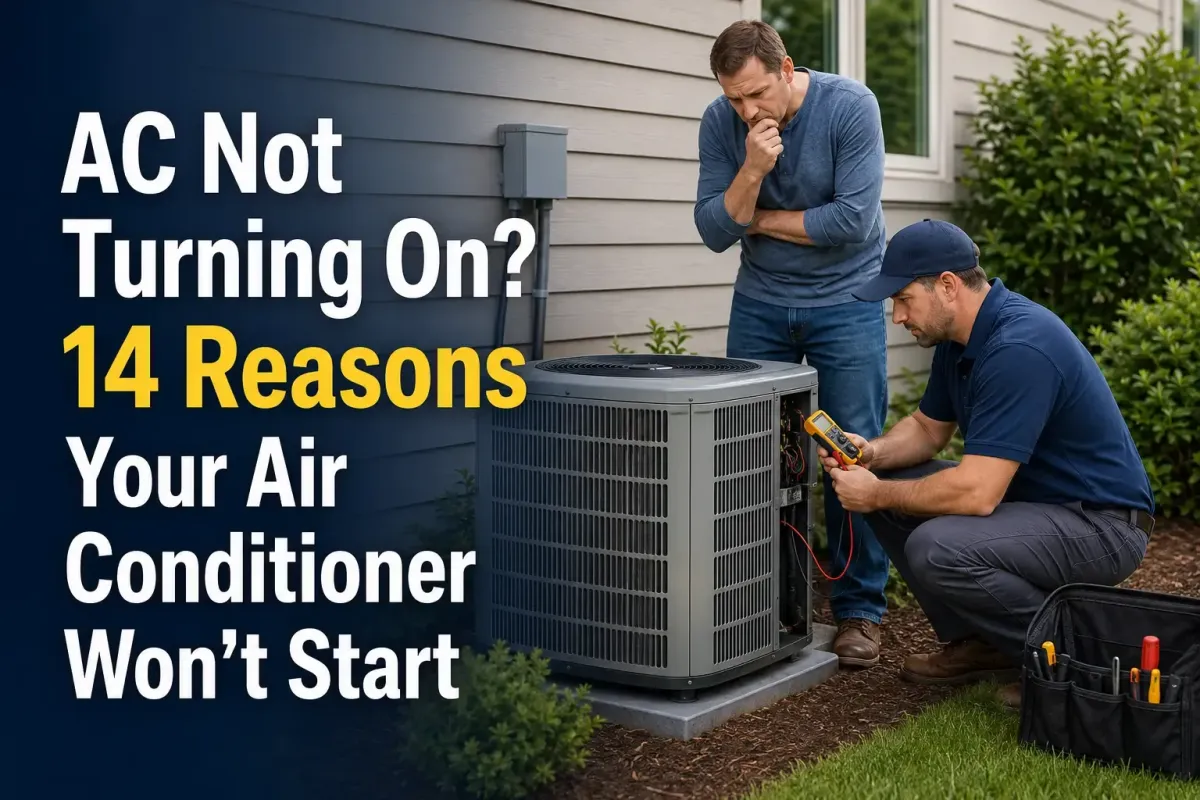
14 Reasons Your AC Unit Is Not Turning On
Let’s look at some of the common reasons you AC unit may not be turning on:
1. The Thermostat Is Set Incorrectly
Incorrect thermostat settings are one of the simplest reasons an air conditioner won’t turn on.
Confirm that the thermostat is set to Cool and that the selected temperature is below the current room temperature.
Set the fan to Auto so it runs during a cooling cycle rather than circulating air continuously.
Smart thermostats may also be affected by schedules, energy-saving modes, connection problems or software delays.
If the display works but the AC does not respond, the problem may involve thermostat wiring, a safety switch or communication with the HVAC system.
2. The System Is in a Built-In Startup Delay
Many air conditioners wait several minutes before starting after a thermostat adjustment, breaker reset or power interruption.
This delay helps protect the compressor from restarting too quickly.
You may hear a click at the thermostat without seeing the outdoor unit start immediately.
Wait about five minutes before assuming the system has failed.
If the delay continues much longer or the unit repeatedly tries to start, another issue may be present.
3. The Circuit Breaker Has Tripped
An air conditioner draws a large amount of electricity when its compressor and motors start.
A power surge, overloaded circuit or failing component may cause the breaker to trip.
Resetting the breaker once may restore operation.
If it trips again, leave it off and arrange for an inspection.
Repeatedly resetting the breaker does not correct the underlying problem and may expose the system to additional damage.
4. The Furnace or Indoor Shutoff Switch Is Off
A central AC depends on the furnace or air handler for indoor airflow and system controls.
If the indoor equipment loses power, the cooling system may not respond.
Check the switch near the furnace and confirm that it is on.
Also check whether the indoor equipment has its own breaker.
If the switch and breaker are both on but the air conditioner remains unresponsive, a fuse, transformer, control board or wiring problem may be involved.
5. A Fuse or Low-Voltage Transformer Has Failed
Central air-conditioning systems use low-voltage electricity to carry signals between the thermostat, indoor equipment and outside unit.
A blown control-board fuse or failed transformer can leave the thermostat blank or prevent the cooling signal from reaching the condenser.
Some outdoor disconnect boxes also contain fuses that can interrupt power to the outside unit.
Do not repeatedly replace a fuse that continues to fail.
A recurring blown fuse often indicates damaged wiring, a short circuit or another electrical problem that should be diagnosed.
6. The Outdoor Disconnect Is Off or Has Failed
The outside AC unit usually has a disconnect box mounted on a nearby wall.
This allows power to be shut off during maintenance and repairs.
The disconnect may have been left off after previous air conditioner service or seasonal work.
Its internal fuse, switch or electrical connection may also have failed.
Homeowners can visually check whether an external disconnect switch appears to be on.
Do not open electrical compartments or touch wiring inside the box or condenser.
7. The Air Filter Is Severely Clogged
A clogged air filter makes it harder for the system to move air across the indoor evaporator coil.
Restricted airflow may cause the coil to become too cold and freeze.
Once ice forms, the AC may stop cooling properly, shut down or run without sending enough air through the vents.
Replace the filter if it is visibly dirty.
If ice is present, turn the cooling mode off and allow the system to thaw naturally.
A recurring frozen coil may be caused by restricted airflow, a dirty indoor coil, blower trouble or a refrigerant issue.
8. The Evaporator Coil Is Frozen
A frozen indoor coil can prevent the air conditioner from operating normally.
Common signs include:
Ice on the refrigerant line
Weak airflow from the vents
Water around the indoor unit
Warm air while the system is running
Long cooling cycles followed by a shutdown
Turn the cooling setting off if you notice ice.
Running the air conditioner while the coil is frozen can place additional strain on the compressor.
Do not chip, scrape or melt the ice with a heat source.
Allow it to thaw naturally and have the cause investigated if the problem returns.
9. The Condensate Drain Is Clogged
Air conditioners remove moisture from the indoor air as they operate.
That water collects in a drain pan and flows away through a condensate line.
Dirt, algae and debris can clog the drain.
Many systems have a float switch that stops cooling when water rises too high, helping reduce the risk of an overflow.
If the thermostat is working but the AC does not start, look for water around the furnace, air handler or drain pan.
A clogged drain may require cleaning, but standing water can also result from a cracked pan, frozen coil or improperly installed drain.
10. The Capacitor Has Failed
Capacitors provide the electrical boost that helps the compressor and fan motors start and continue running.
They can weaken because of age, heat and electrical stress.
A failed capacitor may cause the outside unit to:
Hum without starting
Click repeatedly
Start slowly
Shut off unexpectedly
Run the compressor without the fan
Run the fan without starting the compressor
Capacitors can retain an electrical charge after power has been disconnected.
They should be tested and replaced by a trained technician.
11. The Contactor Is Damaged
The contactor is an electrically controlled switch inside the outside unit.
It receives a low-voltage signal from the thermostat and allows power to reach the compressor and condenser fan.
Over time, the electrical contacts can become worn, pitted or stuck.
A damaged contactor may produce a click without allowing the air conditioner to start.
Testing or replacing it requires access to high-voltage electrical components and is not a homeowner repair.
12. A Fan or Blower Motor Has Failed
Central air conditioners use an indoor blower motor and an outdoor condenser fan motor.
If the outside unit runs but little or no air comes from the vents, the indoor blower may have failed.
If the indoor blower runs but the outside fan remains still, the problem may involve the condenser fan motor, capacitor, wiring or controls.
Possible motor-failure symptoms include:
Humming or buzzing
Burning smells
Intermittent operation
Slow fan movement
Grinding or squealing
A motor that becomes unusually hot
Turn the system off if you notice smoke, a burning smell or loud mechanical noise.
13. Wiring or Control Components Are Damaged
Thermostat wires, low-voltage wiring, relays, transformers and control boards all help the air conditioner start and operate correctly.
Connections can become loose or corroded because of age, moisture and vibration.
Outdoor wiring may also be damaged by weather or rodents, particularly after the equipment has sat unused through a Southern Manitoba winter.
A broken low-voltage wire can prevent the thermostat signal from reaching the condenser even when the indoor blower appears to work.
Avoid opening the condenser cabinet or touching exposed wiring.
Electrical diagnosis requires appropriate testing equipment.
14. A Refrigerant, Pressure-Control or Compressor Problem Has Stopped the System
The compressor circulates refrigerant between the indoor and outdoor sections of the air conditioner.
If the compressor cannot start, the system will not cool the house.
Some systems use pressure switches or other safety controls that can stop operation when refrigerant pressures are outside the expected range.
Low refrigerant does not cause every air conditioner to become completely unresponsive, but a refrigerant leak or abnormal pressure may contribute to freezing, poor cooling or a safety shutdown.
Possible compressor or pressure-related symptoms include:
Loud humming
Repeated clicking
A tripped breaker
The outdoor fan running without cooling
Brief startup followed by shutdown
Warm air from the vents
Ice returning after the system thaws
Not every compressor-related symptom means the compressor needs to be replaced.
A failed capacitor, contactor, damaged wire or control problem may produce similar signs.
A technician can test electrical components, refrigerant pressures and compressor operation before recommending a repair.
Indoor Fan Running but Outside AC Unit Not Turning On
When the indoor blower runs but the outside AC unit is not turning on, the thermostat may be calling for cooling while the condenser is unable to start.
First, make sure the thermostat fan setting is on Auto rather than On.
When the fan is set to On, the indoor blower can circulate air even when the system is not actively cooling.
If the fan is set correctly, possible causes include:
A tripped outdoor breaker
An off or failed disconnect
A blown disconnect fuse
A failed capacitor
A damaged contactor
A faulty condenser fan motor
Broken low-voltage wiring
A control-board problem
A pressure-control shutdown
Compressor trouble
Check that the outside unit is not covered or blocked by debris.
Do not reach through the fan guard or open the electrical access panel.
If the condenser hums, buzzes or repeatedly clicks, turn the air conditioner off rather than allowing it to continue trying to start.
Why Is My AC Humming but Not Turning On?
Humming often means part of the system is receiving electricity but a motor or compressor cannot start.
Common causes include:
A weak or failed capacitor
A seized fan motor
A damaged contactor
Low or unstable voltage
A compressor struggling to start
Turn the system off instead of allowing it to hum for an extended period.
Continued startup attempts can cause overheating or damage to other components.
Do not try to push-start the outside fan with a stick, screwdriver or other object.
The fan may begin moving unexpectedly, and the underlying electrical problem will remain.
Why Is My Thermostat Working but the AC Is Not Turning On?
A functioning thermostat display confirms that the thermostat has power, but it does not confirm that the entire HVAC system is receiving the cooling signal.
Possible causes include:
An incorrect temperature or mode setting
A built-in startup delay
Loose thermostat wiring
A clogged drain and activated float switch
A blown low-voltage fuse
An indoor control-board issue
A tripped outdoor breaker
A failed contactor or capacitor
Damaged wiring between the indoor and outdoor units
Set the thermostat several degrees below the room temperature and wait five minutes.
If the AC still does not respond, check the breakers and look for water near the indoor equipment.
Why Is My AC Not Turning On After Winter?
An air conditioner that worked last summer may not start immediately after sitting unused through a long Southern Manitoba winter.
Possible causes include:
The thermostat is still set to Heat
The furnace switch was turned off
The outdoor disconnect was left off
Leaves or debris collected around the condenser
Wiring was damaged by moisture or rodents
Electrical connections developed corrosion
A capacitor weakened
A motor became difficult to start
A breaker tripped during a power interruption
Before starting the system for the season, clear loose debris from around the condenser and make sure there is room for airflow.
Do not open the equipment or spray water into electrical compartments.
If the air conditioner clicks or hums but does not start, turn it off and arrange for an inspection.
Can You Reset an Air Conditioner That Won’t Turn On?
A reset may restore operation after a brief power interruption, but it will not repair a failed component.
To perform a basic reset:
Set the thermostat to Off.
Find the correct AC breaker.
Move the breaker fully to Off.
Wait several minutes.
Switch the breaker back to On.
Set the thermostat to Cool.
Lower the selected temperature.
Wait for the built-in startup delay.
Some air conditioners have manufacturer-specific reset procedures.
Review the owner’s manual before pressing a reset button.
Only reset the breaker once.
If it trips again, leave the system off and contact an HVAC technician.
Can a Dirty Air Filter Stop an AC From Turning On?
A dirty air filter usually does not cause a complete loss of power.
However, severe airflow restriction can create other problems that interrupt normal operation.
A clogged filter may contribute to:
A frozen evaporator coil
Weak airflow
Blower overheating
Longer cooling cycles
A system safety shutdown
Replace a visibly dirty filter, but do not assume the issue is resolved if the AC still will not start or the indoor coil freezes again.
What Does an HVAC Technician Check When an AC Won’t Turn On?
When basic homeowner checks do not solve the problem, an HVAC technician can test the system to determine where the startup sequence is failing.
Depending on the symptoms, the technician may inspect:
Thermostat settings and cooling signals
Indoor and outdoor electrical voltage
Breakers, disconnects and fuses
The low-voltage transformer
Condensate safety switches
Capacitor condition
Contactor operation
Indoor and outdoor fan motors
Compressor amperage
Thermostat and control wiring
Circuit boards and relays
Refrigerant pressures
System safety controls
This testing helps separate a relatively small electrical failure from a more involved motor, control or compressor problem.
When Should You Call an HVAC Technician?
Call for service when thermostat, filter, switch and breaker checks do not restore operation.
Professional diagnosis is also recommended when:
The breaker trips more than once
The system produces a burning smell
The outdoor unit hums but does not start
The AC repeatedly clicks
The indoor or outdoor fan is not moving
Ice returns after the system thaws
Water is overflowing from the indoor unit
Wiring appears loose, burned or damaged
The system starts and stops repeatedly
The compressor or motor makes unusual noises
Turn the system off immediately if you notice smoke, sparks, exposed wiring or a strong electrical smell.
Should You Repair or Replace an AC That Will Not Turn On?
An air conditioner that does not start may only need a relatively small component, such as a fuse, capacitor or contactor.
It may also have a more involved motor, control-board or compressor problem.
The decision to repair or replace the system depends on:
The age of the equipment
The component that failed
Previous repair history
Overall system condition
Comfort and humidity performance
Replacement-part availability
Current energy use
The estimated repair cost
A single startup problem does not automatically mean the entire AC must be replaced.
Testing the system first provides the information needed to compare the available options.
How to Reduce AC Startup Problems
Not every breakdown can be prevented, but routine care may reduce the likelihood of some common startup issues.
Inspect the air filter regularly during the cooling season and replace it when dirty.
Keep grass, leaves and other debris away from the outside condenser.
Watch for water around the indoor equipment and address unusual noises before the system stops completely.
Seasonal maintenance can also identify weak capacitors, loose electrical connections, drainage concerns and worn components before they lead to a no-start condition.
AC Repair in Southern Manitoba
If your AC is not turning on in your house after you have checked the thermostat, filter, furnace switch and electrical breakers, the system may require professional testing.
Trav’s Plumbing & HVAC services air-conditioning systems for homeowners and businesses throughout Southern Manitoba.
A technician can inspect the electrical controls, motors, drainage system, airflow, refrigerant circuit and other components to determine why the air conditioner will not start.
Avoid repeatedly resetting breakers or attempting repairs inside the outdoor unit.
Providing details about what you hear, which fans are running and whether the thermostat is responsive can help make the service visit more efficient.
FAQs: AC Not Turning On
Why is my AC not turning on in my house?
Your AC may not be turning on because of an incorrect thermostat setting, tripped breaker, off furnace switch, blown fuse or activated safety switch. Electrical components such as the capacitor, contactor, motor or control board may also have failed. Start with the thermostat and power checks before arranging professional service.
Why is my thermostat set to cool but my AC is not turning on?
The system may be in a built-in delay, or the cooling signal may not be reaching the indoor or outdoor equipment. Check the temperature setting, furnace switch, breakers and condensate drain. If the thermostat works but neither unit starts, the system may have a fuse, wiring, control or power problem.
Can a dirty air filter stop an AC from turning on?
A dirty filter usually does not cause a complete loss of power. However, severe airflow restriction can contribute to a frozen coil, blower overheating or a safety shutdown. Replace the filter if it is clogged, but arrange for service if the AC remains off or freezes again.
How do I reset my air conditioner?
Turn the thermostat off, move the AC breaker fully off and wait several minutes. Turn the breaker back on, set the thermostat to Cool and allow time for the startup delay. Do not reset the breaker again if it continues to trip.
What should you do if your air conditioner is running but not blowing cold air?
Check that the thermostat is set to Cool and that the air filter is not clogged. Weak or warm airflow may also result from a frozen evaporator coil, dirty outdoor condenser, blower problem, refrigerant leak or compressor issue. Turn the system off if you see ice, hear unusual noises or notice water around the indoor equipment.
What is the average lifespan of an air conditioner?
A central air conditioner typically lasts about 15 to 20 years, although an air conditioner's lifespan depends on maintenance, installation quality, operating conditions and how frequently it is used. Older systems that need frequent repairs, cool unevenly or use increasing amounts of energy may need to be evaluated for replacement.
